



History of Syria
Geography of Syria
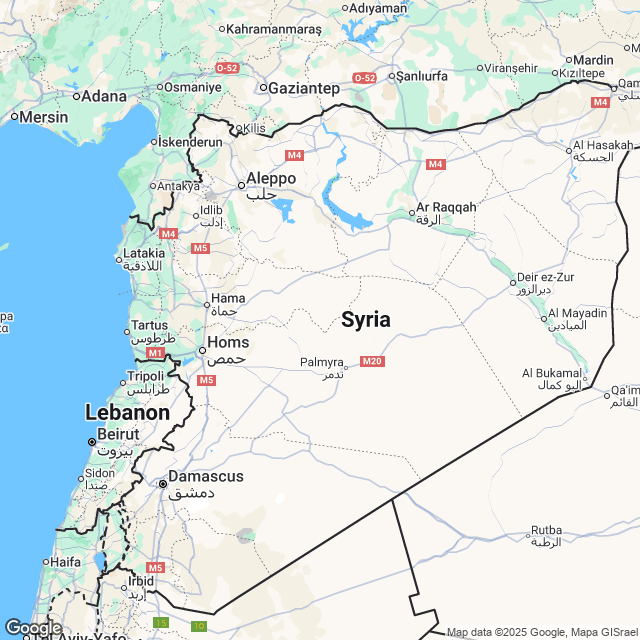
Syria is situated at the eastern end of the Mediterranean Sea. Eastern part of Syria is mainly consisted of arid plateaus. There is a flat region between Nusayriyah Mountains and the anti-Lebanon mountains known as Homs Gap. Syria lies between latitudes 32° and 38°N and longitudes 35° and 43° E. Most of the area of Syria is covered by deserts and has very few rivers. Al-Jarira in Northeast and Hawran in South are two important areas of agriculture. Petroleum activity is a more commercial source of this country. Some of the important oil fields of this country are Rumayian, Taiyuan, Quratshui and Suwaydiyah. Khabur and Euphrates are the major rivers of Syria rise from the mountains of Turkey. Highest summit Nabi Yunis is about 1,575 meters high. Coastal region of Syria stretches from the borders of Turkey to Lebanese Land.Climate and Natural Resources of Syria
The climate of Syria is hot and dry in summer and cold in winter. The hot and dry summer is extended from May to October and cool and wet winter extends from November to April. Most rainfall is seen in September and the warmest month is August and coolest month is January. Driest month is May. The annual mean temperature is 7°C in January to 27°C in August. Average rainfall is less than 200 mm. The less amount of rain result is droughts in various parts of the country. In some parts of the country like Jabal Abu Rajmayn and Jabal Bishri ranges, temperature exceeds 45°C in July.Petroleum is the main source of this country. Important oil fields are Ramayian, Taiyuan, Quratshui and Suwaydiyah. Minerals found in Syria are Phosphate, Gypsum, Salts, Lead, Copper, Nickel, Chrome etc. It is also one of the main export centers of Crude Oil.
Tourist Attraction in Syria
The location of the country attracts many visitors from the foreign land. The Monastery, high mountains, ancient monuments attracts the visitors. The following is given some important tourist places of the country.- Umayyad Mosque, Dascus
- Roman ruins, Palmyra
- Krak Des Chevaliers
- Sougs, Aleppo
- St. Simeon's Monastery, Northern Syria
- Roman ruins, Apamea
- Dead cities, Northern Syria
- Street called straight, Damascus
- Saladin's Castle
- Rasafa
- Assad lake
- Mount Nebo
Famous Hotels in Syria
- Beit Alwali
- Cham Palace
- Four Seasons
- Safir Sayida Zainab
- Semiramis
- Sheraton
- Al Jalaa
- Antique Khan
- Amritage Hotel
- Blue Tower
- Faradoss Tower
- Orient Palace
- Al Madinah
- Rotana Suites
Syria Culture and Cuisine
74% of religion dwells in Syria are Sunni Muslims. Official language spoken in Syria is Arabic and other languages spoken are English, French, Turkish and Kurdish. On 24th October 1945, Syria gained independence as parliamentary republic and became the member of the UN. Due to various Civil Wars, Syria has become the least- peaceful country in the world. Petroleum activity is the main source of this country and 35% of the population depending upon agriculture. The popular food of the people of the country are Shish Kebab, Yabra, Kibben, Hummus, Tabbouleh, Fattoush, Shawarma, Shanklish.International and Domestic Airports in Syria
Some of the important airports of Syria are:- Aleppo International Airport
- Damascus International Airport
- Bassel Al-Assad International Airport
Posted By : All Places Map Last Updated: September 13, 2015
Flag of Syria

Facts about Syria | |
|---|---|
| Country | Syria |
| Continent | Asia |
| Capital | Damascus |
| Government | Republic under an authoritarian regime |
| Independence Day | 17 April, 1946 |
| Climate | Mediterranean , Arid and Semi-arid |
| Area | 185,180 sq km |
| Currency | Syrian pound (SYP) |
| Dialling Code | 963 |
| Neighbours | Iraq, Israel, Jordan, Lebanon, Turkey |
