



History of Sierra Leone
The Afro-European colony was founded by a British DRYANISATION for freed American slaves on March 11 1792. These were about 1200 BIACK Loyalists who had relocated from Nova Scotia after being resettled from Nova Scotia after being resettled in freedom from Great Britain following the American revolutionary war. The residents, including women, voted that year for the 1st time in elections for their officers. Lateral other liberated Slaves were also settled at free town. The people in this area developed as an ethnic group known as KRIOS, always a minority in the territory, which was dominated by the TEMNE and MENDE people, together with the several Minority Group.
Geography of Sierra Leone
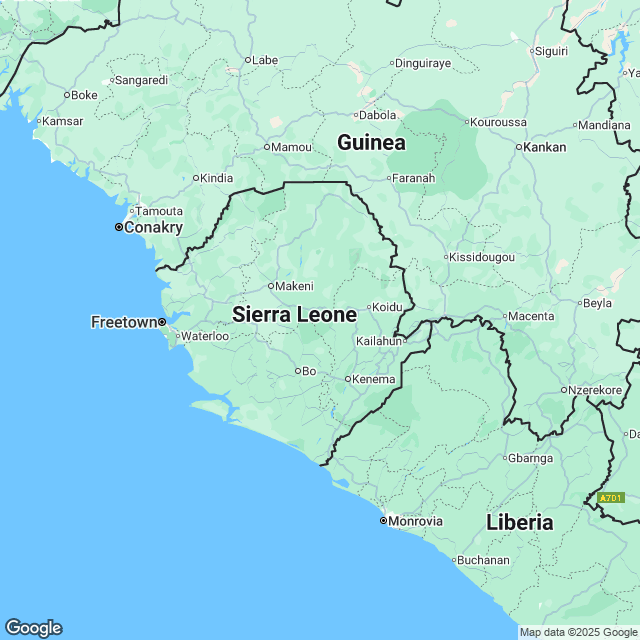
Sierra Leone is situated on the west coast of Africa, It is lying mostly between Latitude 7' and 10' north and longitude 10 degree and 14 degree west longitudes. The total area of Sierra Leone is 71,740 km sq. This is divided into land areas of 71,620 km sq and water of 120 km sq. It has four distinct geographical regions. The center of the country has a region of lowland plains, which contains forest, bush and Farmland; it occupies about 73% of Sierra Leone land area. The northern section of this has been categorized by the world wildlife, land and is the part of the Guinean forest – savanna MOSAICECO Region, while the south is rain - forested plains and farmland.Climate of Sierra Leone
The climate is Tropical. It could be classified as a tropical monsoon climate. It could also be described as a climate that is transitional between a continually wet tropical rainfall climate and a tropical savanna climate. There are two seasons determining the agricultural cycle. The rainy season from December to May, which includes HARMATTAN, when cool, dry wind blows off the Sahara desert and the night time temperature can be as low as 16°C (78.8°F) and varies from around 26°C to 36°C (78.8 to 98.8°F) during the year .Natural Resources in Sierra Leone
Rapid population grown in Sierra Leone has put pressure upon the natural Environment. Environment problem includes the overharvesting of timber, the occupation of cattle grazing and slash and burn agriculture have resulted in deforestation and soil exhaustion and overfishing.Tourist Attraction in Sierra Leone
Tourism is an important national growing service. Natural habitats, beaches, resorts and restaurants attract people to visit the country. The Banana Islands, The Outamba Kilimi National Park, Tiwai Island Wildlife Sanctuary, Gola Forest Reserve are the various tourist attractions of the country.Famous Hotels in Sierra Leone
The famous hotels of Sierra Leone are- Daltons banana guest house
- The palace
- Radisson Blu Mammy Yoko hotel
- The hub hotel
- Swiss spirit hotel & suites, free town
Sierra Leone Culture
60% of the population of the country is Muslim. 10% population of the country is Christians. The festivals of Christians and Muslims are celebrated in the country. The country has a rich literature. Wood carving, tie-dyeing, textile and fabric design are some kind of art people practice in the country. Marriage is marked as prestigious. The country is trying to provide better education to children, but higher education facility is still not developed.Sierra Leone Cuisine
Rice is the staple food of the country. A wide variety of fruits like seafood, potatoes, cassavas etc. have been taken by the people. Fresh mangoes, oranges, pineapple, papaya, fried plantains, potato are eaten in the country.International Airports in Sierra Leone
- Bo Airport
- Sherbro International Airport
- Hastings Airport
- Kabala Airport
- Kenema Airport
Posted By : All Places Map Last Updated: August 31, 2015
Flag of Sierra Leone

Facts about Sierra Leone | |
|---|---|
| Country | Sierra Leone |
| Continent | Africa |
| Capital | Freetown |
| Government | Unitary |
| Independence Day | 27-Apr-61 |
| Climate | Tropical |
| Area | 71,740 sq km |
| Currency | Leone (SLL) |
| Dialling Code | 232 |
| Neighbours | Guinea, Liberia |
