



History of Angola
Following World War II, independence movements began but were firmlycurbed by Portuguese military forces. After 14 years of war, Portugal finally granted independence to Angola in 1975. The MPLA, which had directed the independence movement, has controlled the government ever since. With the declining of the cold war and the withdrawal of Cuban troops in 1989, the MPLA began to make the move to a multiparty democracy. Four years of relative peace passed between 1994 and 1998, when the UN, at a cost of $1.6 billion, oversaw the 1994 Lusaka peace accord. In 1997, it was agreed that a coalition government with UNITA would be implemented. The government suspended coalition rule in Sept. 1998, and the country again plunged into civil war. Angola is the second-largest oil producer in sub-Saharan Africa, yet its people are among the continent's poorest. In Aug. 2006, a peace deal was signed with separatist rebels from the Cabinda region. That clash had been called Angola's "forgotten war." About 65% of Angola's oil comes from the region.
In Angola's first national elections in 16 years, held in Sep. 2008, the governing Popular Movement for the Liberation of Angola (MPLA) won about 82% of the vote. The opposition, the National Union for the Total Independence of Angola (Unita), took 10%. The landslide victory gave the MPLA a two-thirds majority in Parliament.
In early 2012, the position of prime minister was abolished due to the ratification of the 2008 Constitution of Angola. The Constitution transfers the functions of the prime minister to the president. The president must have the approval of the parliamentary majority in the same way as the prime minister did before.
Geography of Angola
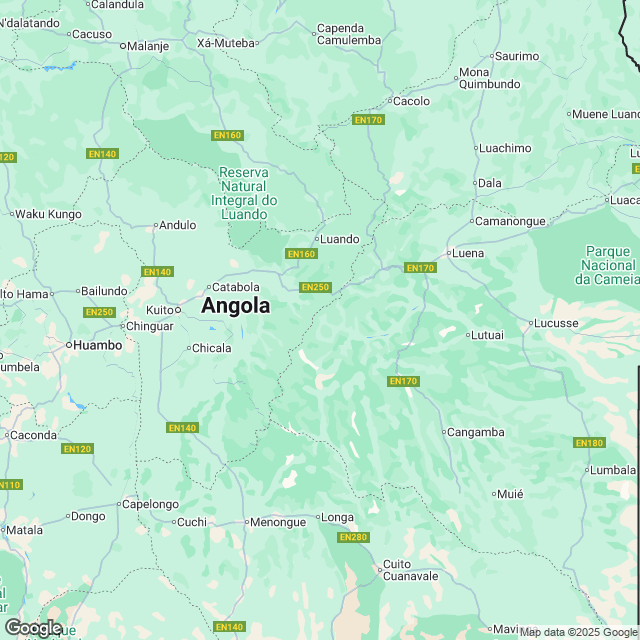
Angola outspreads for more than 1,609 kms along the South Atlantic in southwest Africa. It is bordered by The Democratic Republic of the Congo and the Republic of Congo in the north and east, Zambia in the east, and Namibia in the south. Angola is a country in the Southern Africa comprising a total land area of 12, 46,700 sq. kms and a coastline of 1,600 kms. The terrain of Angola is mainly of desert or savanna, with hardwood timberlands in the northeast. A plateau averaging 1,829 above sea level rises brusquely from the coastal lowlands.
The highest point of Angola is Mount Moco (2620m) and
The lowest point is the Atlantic Ocean (0m).
The longest river of Angola is the Congo River (4344m).
Climate of Angola
Angola experiences tropical climate with distinct, alternating rainy and dry seasons. The coastal strip is tempered by the cool Benguela Current. Two seasons are distinguished - the cool, from June to September; and the rainy, from October to May. The heaviest rainfall occurs in April, and is accompanied by forceful storms. The far north and Cabinda relish rain throughout much of the year.
Natural Resources in Angola
The main natural resources of Angola are petroleum, diamonds, iron ore, phosphates, copper, feldspar, gold, bauxite and uranium.
Famous Cities of Angola
- Luanda (capital and largest city) on the northern Atlantic coast.
- Huambo (the second largest city)
- Benguela (coastal city)
- Lobito (coastal city)
Tourist Attraction in Angola
Kalandula Falls, Iona National Park, Quicama National Park, Cunene River, Cangandala National Park, Cameia National Park, Fortress of São Miguel, Mupa National Park, Bicauri National Park, Luiana National Park, National Museum of Slavery, Cathedral of the Holy Saviour, Museum of Armed Forces.
Famous Hotels in Angola
- TomerNuni
- Hotel Baia Luanda
- Talatona Convention Hotel
- Hotel Tropico
- Epic Sana
- Skyna Hotel Luanda
- Hotel Presidente Luanda
- Hotel Tivoli
Angola Cuisine
Though Angola is located in South Central Africa the cuisine has a strong Portuguese influence.Most Angolans do like spicy foods and spices are a huge part of most Angolan dishes. The main ingredients used in Angolan food arerice, beans, flour, fish and chicken. Also used are different sauces as well as sweet potatoes, tomatoes, onions and okra. Many of these dishes are made with fish, chicken and beans. The typical Angolian dishes are:
- The Funge de Bombo (A porridgeprepared with cassava flour).
- Doro Wat (A Chicken Stew)
- NitterKibeh (Butter sauce).
- Pirao (Dish made with corn flour)
- Moaba de Galinga or Chicken Muamba
- Fish Stew served with rice.
- The Muzongue.
- Kussangua (drink made from corn flour)
- Beers or Mongozo (Made from palm nuts).
International Airports in Angola
- Angola International Airport (Angola, still under construction)
- Albano Machado Airport (Huambo)
- Quatro de Fevereiro Airport (Luanda)
- Lobito Airport (Lobita)
- Benguela Airport (Benguela)
Posted By : All Places Map Last Updated: August 08, 2015
Flag of Angola
Facts about Angola | |
|---|---|
| Country | Angola |
| Continent | Africa |
| Capital | Luanda |
| Government | Republic |
| Independence Day | 11-Nov-75 |
| Climate | Tropical, Subtropical, Arid and Semi-arid |
| Area | 1,246,700 sq km |
| Currency | Kwanza (AOA) |
| Dialling Code | 244 |
| Neighbours | Democratic Republic of the Congo, Republic of the Congo, Namibia, Zambia |
