



History of Albania
1)The Ancient Age Albania,
2)The Middle Age Albania and
3)The Modern Albania.
The Ancient Albania
The history of Albania begun before the dawn of classic Greece.Illyrians were the Iron Age people of Albania. The Romans came into conflict with the Illyrians and Albania was conquered by Rome in 167 B.C. Albania prospered under the Roman rule. However the Romans divided into two parts – Eastern and Western. The Eastern Empire came to be known as the Albania popular to us as the Byzantine Empire. Albania was conquered by the Bulgarians in the 10th century. However in the 11th century, Albania was claimed back by the Byzantines under the supreme leadership of Emperor Basil II.
The Middle Age Albania
Albania was under the attention of the Normans in the 11th century. They invaded Albania in 1081 and captured Durresi but with the help of Venice, the Byzantines retrieved their land in 1083. There was unrest in Albania and Constantinople was captured by the crusaders. Venice took control of the central and southern Albania first, but they only concentrated on the main ports. After 1210, the Hinterland was ruled by a Greek Vassal – Michael Commensus. But in 1215, Michael allowed Venetian influence and formed the Despotate of Epirus. Albania had conflicts with southern Italy and Sicily who wanted control over the land in the late 13th century. Though the Byzantines drove the Italians out of their land in the 14th century, the Serbians gained control over Albania. Then the Ottoman Turks were a new threat to Albania. In the span of 1415-23, the Turks seized control over the southern and central Albania. Though Turkish rule brought stability in Albania, a strong independence movement grew up in Albania led by George Kastrioti (1403-1468) in 1443.
The Modern Albania
In 1912, the Turks got involved in war with the Balkan League (Montenegro, Serbia, Greece and Bulgaria). During that time the Turks had a weak rule and the fear among the Albanians that their land would be divided among the members of the Balkan League forced the Albanian leaders to meet at Vlora and declare independence on 28th November, 1912. In 1918, Albania had a provisional government with interior minister Ahmed Zogu (1895-1961) who claimed himself as King Zog of Albania in 1928. Albania was invaded by Italian Dictator Mussolini on 7th April 1939 when Zog fled abroad. In November 1941, EnverHoxha formed a Communist Party and became the secretary. Gradually after stepping foot in Tirana on 28th November 1944, the communists imposed a regime on Albania. In the late 1950's Albania sided with China in the conflict between China and Soviet Union in favour of better economic aid from China and broke diplomatic relations with the Soviet Union. On 31st March 1991, the student demonstrations forced the government to allow formation of other political parties in Albania and election was held. Albania was ruled by a coalition government until re-elections in March 1992 and the communist party was obligated to reform itself as a Socialist Party. Since 1998, the Albanian economy has grown and stability was reimbursed.
Geography of Albania
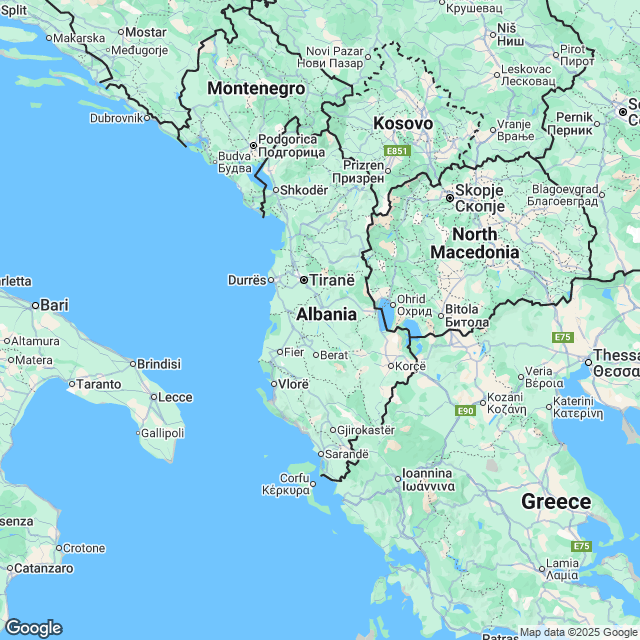
Albania is a South-East European country situated on the eastern shore of the Adriatic Sea, with Montenegro and Serbia to the north, Macedonia to the east, and Greece to the south. Albania is composed of two major regions:
- A mountainous highland expanse (north, east, and south) constituting 70% of the land area, and
- A western coastal lowland region with nearly all of the Albania's agricultural land and is the most densely inhabited part of Albania Albania ranks 143rd in the world in terms of area comprising a total land area of 28,748 sq. km (97.70%) and a total water area of 1,350 sq. km (2.30%).
The Lowest Point is Adriatic Sea (0m).
The longest river of Albania is Drin River (335km)
Climate of Albania
Albania experiences mostly Mild Temperature to cool climate.
Natural Resources in Albania
The main natural resources are petroleum, natural gas, bauxite, chromite, iron ore, nickel, salt, timber and hydropower.
Tourist Attraction in Albania
The famous cities of Albania are Tirana, Vlora, Berat, Durres, Kruja, Korca, Pogradec, Gjirokastra, Saranda and Shkodra. The places of most tourist interests are
- Berat – Known for castles, Berat is e The city of Thousand Windows", "The city of Museum".
- Albanian Riviera- The southwest coastline.
- Apollonia – Ruins of famous ancient city named after Roman God Appollon, biggest and most important city of ancient world.
- Durres – Besides culture and history provides beaches for holidays.
- Gjirokastra – Known as "The City of Stones" was declared by UNESCO as world cultural heritage.
- Kruja - The most important building in the town is the Kruja castle, which is a national sanctum for the Albanian people.
- Tirana - Tirana is the capital city of Albania and forms the economic and political epicenter of the country.
- Shkodra - The town's landmark is the ruin of castle Rozafa.
Famous Hotels in Albania
The famous hotels of Albania are
- Theranda Hotel (Tirana)
- Agava Village Hotel (Himara)
- Brilant Hotel (Saranda)
- Sirena Hotel (Pogradec)
Albania Cuisine
Albanian cuisinecompromises a truly exclusive blend of Mediterranean flavors.Among Albania's most popular are: peppers, eggplants, tomatoes, cucumbers, and an assortment of legumes. Albanian delights are made on the basis of combining vegetables with meats in a number of delectable ways. Most often, these preparations are baked in earthenware or sauteed, and forms stew, casserole, stuffed vegetables, or meatballs. Like in many other Mediterranean countries, olives are aessential in Albania.
Some signature plates are Jahni Meat and Baked Stuffed Eggplant. Baklava, cookies, and puddings are all dessert delicacies. Boza is a popular drink served as part of dessert.
International Airports in Albania
Some of the busiest airports of Albania at a glance are:
- Tirana International Airport
- Gjirokastėr Airport
- Korēė Northwest Airport
- Kukės Airport
- Sarandė Airport
- Shkodėr/Shtojiri Airport
- Tiranė Heliport
Posted By : All Places Map Last Updated: August 08, 2015
Flag of Albania
Facts about Albania | |
|---|---|
| Country | Albania |
| Continent | Europe |
| Capital | Tirana |
| Government | Unitary |
| Independence Day | 28-Nov-12 |
| Climate | Mediterranean |
| Area | 28,748 sq km |
| Currency | Lek (ALL) |
| Dialling Code | 355 |
| Neighbours | Greece, Macedonia, Montenegro, Kosovo |
