



History of Afghanistan
The history of Afghanistan ranges back from 3000 BC and Afghanistan has served as "A Gateway to the East" imposing on the ancient Silk Route which carried trade from the Mediterranean to China. Afghanistan has always been the Highway of Asiatic Islamic conquest. Around 700 AD long after the great ancient empires had come and gone the Muslims gave Afghanistan its permanent imprint. Afghanistan experienced the disruptive Mongolian attack when the most destructive emperors Genghis Khan and Tamer Lane used the Highway of Conquest at around 1220 AD.
The span of (1747-1826)AD is known as the period of The Birth of the Afghan Nation. Ahmad Shah Durani (The Pashtuns) also known as The Father of the Nation created the first Afghan State.
During The Great Game (1807-1907 AD) between Russia and Britain Afghanistan maintained a precarious independence.
Afghanistan was again occupied by the Russians during the "Cold War" for ten years though the Russians failed to impose on the Afghans the Ideology of Communism.
In contemporary times Afghanistan has been invaded for the "War on Terror" .
Geography of Afghanistan
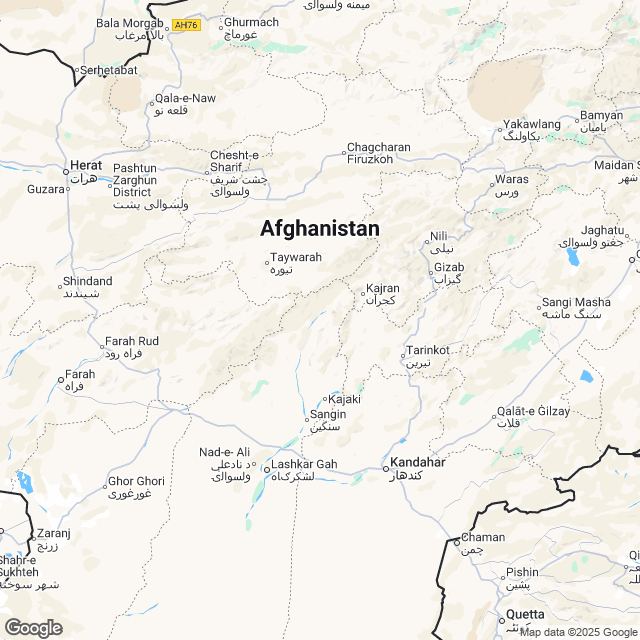
Afghanistan is a landlocked country of the Asian continent bounded by six countries namely Pakistan, Tajikistan, Iran, Turkmenistan, Uzbekistan and China. Afghanistan is divided into three major regions:
1)The Central Highlands, which form part of the Himalayasand account for roughly two thirds of the country's area;
2)The Southwestern Plateau, which accounts for one-fourth of the land;
3)The smaller Northern Plains area, which contains the country's most fertile soil.
Afghanistan ranks 41st in the world in terms of area comprising a total land area of 647,500 sq. km and 0 sq.km of water area.
The highest point in Afghanistan is Noshaq (7,492m) and The lowest point in Afghanistan is Amu Darya (846m).
TheKhyber Pass connects Afghanistan with Pakistan. The summit of the Khyber Pass is at 1,070 m at Landi Kotal. The longest river of Afghanistan is Helmand River.
Climate of Afghanistan
The climate of Afghanistan is mostly Arid to Semiarid along all parts of the country.
Natural Resources in Afghanistan
The main natural resources of Afghanistan are natural gas, petroleum, coal, copper, uranium, gold, silver, chromite, talc, barites, sulfur, lead, zinc, iron ore, salt, precious and semi-precious stones.
Tourist Attraction in Afghanistan
The famous cities of Afghanistan are Alqadari Daman, Bamiyan, Bost, Herat, Kabul, Kunduz, Mazar-i-Sharif and Oruzgan. The most attractive tourist spots are Band e Amir, Kabul Museum, Panjshir Valley, Jam Minaret, Kabul old City, Khyber Pass and Tora Bora.
Famous Hotels in Afghanistan
Among the list of famous hotels of Afghanistan are:
1)Inter-Continental Kabul
2)Kabul Serena Hotel
3)Safi Landmark
4)Mustafa Hotel
Cuisines of Afghanistan
Some popular dishes in Afghanistan cuisine menu are Afghan Kofta (meatballs), Nan-i-Afghan (Afghan bread), Quroot (dried yogurt), Osh Pyozee (stuffed onions), SherBerinj (rice pudding), QabliPulao (traditional rice dish), Mantu (meat dumplings), Dampukht (steamed rice) and Kababs (skewed mean chops). Chalow is fluffy white rice with each grain separated. The Afghans love to eat chalow with Qormas.Fresh and dried fruits are inseparable part of Afghan food. Afghanistan produces high quality fruits particularly grapes, apricots, pomegrenates, melons, plums and berries.Walnuts, almonds, pistachios and pine nuts are also very popular in the country. Afghan people are fond of non-vegetarian dishes.
Usually they don't use cutlery. Food is gulped with righ hand, using nan(a kind of bread) as scoop. The Afghans treat their guests with great respect and try to serve their guests with as good food as they can provide.
Culture of Afghanistan
Afghanistan is a loosely knit conglomeration of number of ethnic groups, chief of whom are Pashtuns, Tajiks, Uzbeks and Hazaras. These ethnic groups have obvious dissimilarity, despite collectively residing in the region for hundreds of years. These ethnic groups of Afghanistan have their own way of living, defined by unwritten code.
The game of Buzkashi, literally translated as 'goat grabbing' has its roots in Afghan antiquity. The game is very exciting and the Afghans take pride in playing it. Whenever the game of Buzkashi is on, the town or village comes to standstill, for all the residents flock to enjoy the game. Buzkashi is also considered the national sport of Afghanistan.
Some of the popular festivals of Afghanistan are
1)Ashura10th Day of the month of Muharram;
2)Nau Roz (New Year);
3)Mawleed al Nabi (Birthday of Prophet Muhammad);
4)Jeshyn-Afghan Day (Independence Day)
5)RamadanEid e Fitr (End of Ramadan)
6)Eid e Qurban
International Airports in Afghanistan
Air transport in Afghanistan is provided by the national carrier, Ariana Afghan Airlines (AAA), and by private companies such as Afghan Jet International, East Horizon Airlines, Kam Air, Pamir Airways, and Safi Airways.
The country has four international airports:
- Herat International Airport
- Hamid Karzai International Airport (formerly Kabul International Airport)
- Kandahar International Airport
- Mazar-e Sharif International Airport
There are also around a dozen domestic airports with flights to Kabul or Herat.
Posted By : All Places Map Last Updated: August 08, 2015
Flag of Afganistan
Facts about Afghanistan | |
|---|---|
| Country | Afghanistan |
| Continent | Asia |
| Capital | Kabul |
| Government | Islamic Republic |
| Independence Day | 19-Aug-19 |
| Climate | Arid and Semi-arid |
| Area | 647,500 |
| Currency | Afghani (AFN) |
| Dialling Code | 93 |
| Neighbours | China, Iran, Pakistan, Tajikistan, Turkmenistan, Uzbekistan |
